
Why Cyber Resilience Trumps the Illusion of 100% Prevention
For years, enterprise cybersecurity was treated like a medieval fortress: build the walls high enough, dig the moat deep enough, and nothing gets in. Organizations poured millions into perimeter defenses under the comfortable assumption that complete prevention was achievable.
Today, that mindset is not only outdated – it is dangerous.
The complexity of modern IT ecosystems, hybrid work models, cloud migrations, and AI-driven automated attacks means the perimeter no longer exists in a single, controllable boundary. If your security posture is predicated entirely on keeping every threat out, your organization has a catastrophic single point of failure.
The hard truth of contemporary enterprise security is simple: It is no longer a question of if your systems will be challenged, but when.
If your organization was attacked tomorrow, would you be ready?
The Flaw of the “Impenetrable Fortress”
Prevention remains essential, but treating it as a silver bullet creates a false sense of security. Attackers only need to find a single misconfigured port, an unpatched third-party dependency, or an employee having a rushed morning who clicks on an invoice attachment. By contrast, internal security teams must successfully defend every single asset, every minute of every day.
When an organization operates purely on prevention, incident discovery triggers immediate chaos:
- Teams don’t know who has decision-making authority during an ongoing intrusion.
- Critical internal systems lack lateral isolation, allowing an attacker to pivot across corporate segments unchecked.
- Backups and recovery pipelines haven’t been tested under real crisis conditions, dragging recovery from hours into weeks.
True security mature leaders don’t measure capability solely by how many intrusions they block; they measure it by how effectively their operations survive an active compromise.
Shifting from Prevention to Resilience
Cyber resilience assumes that an adverse event – whether a ransomware attempt, a supply-chain vulnerability, or credential theft – will eventually occur. Instead of paralyzing the business, resilient architectures ensure operational continuity.
At Godonga Technologies, our cybersecurity philosophy is anchored in four operational pillars designed to absorb shocks rather than collapse under them:
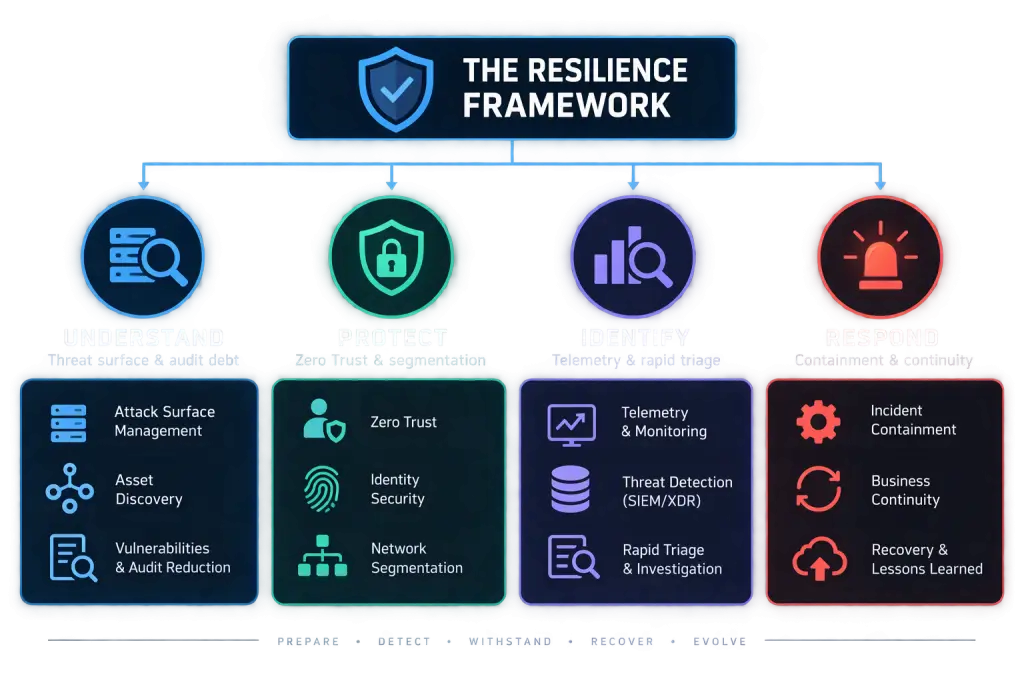
1. Understanding Potential Risks
You cannot protect what you cannot see. Cyber resilience starts with continuous posture visibility: identifying outdated legacy debt, auditing third-party integrations, and mapping out critical data workflows.
2. Protecting What Matters Most
Not all data carries identical business value. A resilient posture prioritizes core assets through rigorous access governance and network segmentation. If an endpoint is compromised, robust segmentation prevents lateral movement into mission-critical financial, operational, or customer databases.
3. Identifying Threats Proactively
Detection must occur at the threshold, not months after exfiltration begins. Resilient enterprises utilize clear monitoring signals, automated telemetry, and baseline behavioral tracking across identities and gateways.
4. Readiness to Respond and Recover
When an incident takes place, containment must be swift, scripted, and practiced. Disaster recovery and business continuity plans (BCP) should be living engineering frameworks—regularly exercised, stress-tested, and refined.
Building an Infrastructure That Survives the Click
A resilient architecture accepts human error and technical anomalies as operational realities. When an employee slips or an edge service is exploited, layered controls – ZeroTrust network access, strict endpoint isolation, and automated quarantine – limit the blast radius.
The objective is simple: ensure that an isolated breach never cascades into full operational paralysis.
Is Your Organization Ready for Tomorrow?
Resilience is not a product you buy off the shelf; it is an architectural commitment to visibility, governance, and rapid containment.
If an incident struck your network tomorrow:
- How fast would your team isolate the threat?
- Could your core business operations continue unaffected?
- Are your compliance, data retention, and disaster recovery workflows tested?
Don’t wait for a crisis to expose your structural gaps. Partner with Godonga Technologies to assess your infrastructure, eliminate blind spots, and build verifiable resilience across your enterprise.
📩 Contact our technical consulting team: sales@godonga.co.za